
.jpg)



The Environmental Improvement Plan (EIP) 2025 is the UK government’s statutory roadmap for restoring and enhancing England’s natural environment to 2043, structured around 10 goals across five chapters: restored nature, environmental quality, circular economy, environmental security, and access to nature. It tightens interim targets from the Environment Act, sets out over 80 commitments with illustrative action plans, and explicitly links nature recovery to missions on economic growth, health, safer streets, opportunity, and clean energy.
The plan positions nature as critical national infrastructure underpinning health, economic resilience, and security. It highlights nature’s annual service value for England and the GDP risks from biodiversity loss, degraded soils, and water scarcity.
It revises the previous EIP to provide more detailed interim targets, clearer governance and monitoring, and stronger alignment with climate, energy, planning and economic policy. An EIP Board will coordinate delivery across government.
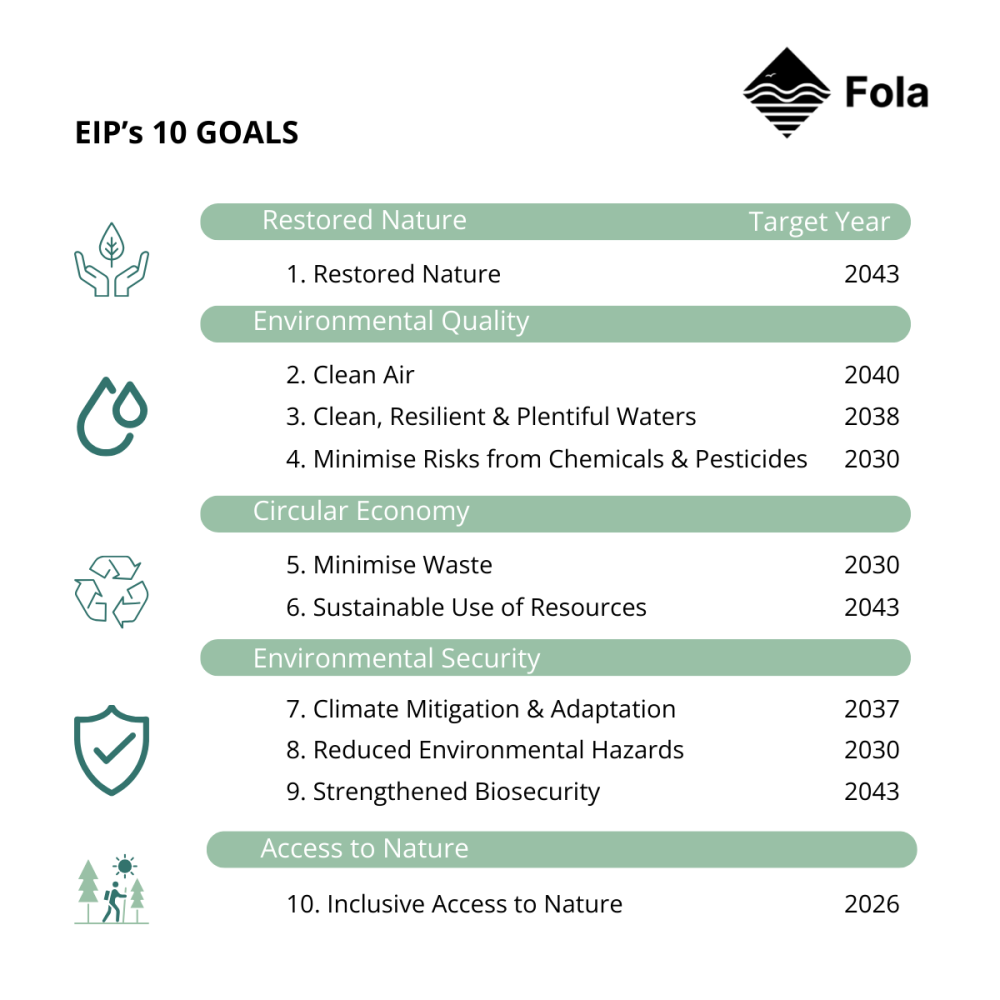
The EIP sets one overarching goal of “restored nature” supported by 9 further goals: cleaner air, cleaner water, safer chemicals and pesticides, reduced waste, resource efficiency/circular economy, climate, environmental hazards, biosecurity, and access to nature.
Progress will be measured through the Environmental Indicator Framework and annual progress reports, with updated interim Environment Act targets (for example on species abundance, waste, and invasive species) and supplementary delivery plans.
England’s new Environmental Improvement Plan (EIP) 2025 is not just another policy document; it is the clearest signal yet that nature is now core to economic infrastructure and that businesses will be expected to act accordingly. For Fola, this marks a turning point for England: nature is firmly moving from the margins to the heart of strategy, risk and value creation for corporates and financial institutions.

The EIP explicitly frames nature as an asset base worth over a trillion pounds, with ecosystem services delivering billions of pounds in annual benefits and shielding the economy from climate and nature-related shocks. At the same time, it is up front about the scale of nature depletion in England and the GDP, supply chain and social risks that will follow if this trajectory continues.
For businesses, this is the language of core infrastructure, not philanthropy. Government ambition is rising on restoring nature, cleaner air and water, and a circular economy. As a result, nature moves squarely into the realm of fiduciary duty, resilience, long-term competitiveness and licence to operate.
The plan has ten goals reaching from restored nature and environmental quality to climate, hazards, circular economy and biosecurity. These goals are underpinned by statutory Environment Act targets and detailed interim milestones to 2030 and beyond. These goals are explicitly tied to mission-driven priorities on growth, a resilient NHS, safer streets, opportunity for young people and clean energy, making nature integral to the wider economic and social agenda.
For corporates and financial institutions, the implication is clear: nature is becoming a regulated performance area, not a voluntary add‑on. The EIP will intersect with planning, permitting, water and waste regulation, and sectoral policy and therefore with capital allocation, operating models and board-level risk oversight.
The EIP sits alongside and reinforces a rapidly tightening global reporting and governance landscape, including new ISO standards on biodiversity, ISSB’s incorporation of TNFD recommendations, and emerging regulations such as EUDR, CSRD and other nature-related requirements. It highlights the central role of Environment Act targets, biodiversity duties for public bodies, and environmental principles that must be applied across government, all of which translate into new expectations for business conduct, disclosure and due diligence.
As TNFD adoption accelerates and CSRD rolls out (one day) double materiality assessments, the EIP provides a domestic policy anchor that will shape how “nature materiality” is interpreted in the UK context. Companies that treat these developments as a fragmented reporting burden risk missing the bigger picture: this is the architecture for a nature‑positive real economy, and those who lay the groundwork will gain strategic advantage.
The EIP is explicit that public finance alone cannot deliver its goals, and it calls for a “whole-economy” approach to mobilising private investment into nature-positive solutions. It points to the rapid growth of nature-related businesses and to regulation-driven markets such as biodiversity net gain, as well as voluntary mechanisms like woodland and peatland carbon codes.
For investors and lenders, this creates a dual opportunity: mitigating portfolio nature-related risks while allocating capital into emerging asset classes that restore ecosystems, stabilise supply chains and support just transition objectives. For real-economy companies, the direction of travel is towards business models that internalise nature costs and generate measurable positive outcomes for ecosystems and communities.
This section highlights two chapters of the Environmental Improvement Plan that carry particular weight for the real economy: the circular economy and the climate–resilience agenda. Together, they signal a clear direction for business. They show where policy is heading, where investment will flow, and how companies can act now to build competitiveness while supporting national environmental goals.
The circular economy chapter reframes waste as a symptom of systemic inefficiency and lost economic value. It sets out firm commitments: residual waste caps, extended producer responsibility, deposit return schemes, and a circular economy growth plan by 2026. The underlying message is that significant amounts of resources, from edible food to municipal materials, are currently being lost, with knock‑on effects for emissions, nature and costs.
For businesses, this is about much more than compliance with packaging reforms or landfill restrictions. It is about designing products and value chains that regenerate natural capital, reduce exposure to volatile resource markets, and unlocking new service-based and secondary-material revenue streams aligned with nature-positive outcomes.
The climate and hazards chapters place nature at the centre of England’s approach to adaptation. Nature is central to adaptation and resilience, with large-scale investments planned for flood and coastal defences, natural flood management, drought resilience and climate-proofed treescapes and peatlands. It positions nature-based solutions as dual-benefit interventions that manage physical risks while delivering biodiversity, carbon and community co-benefits.
Boards and risk committees will increasingly be expected to understand how their assets and supply chains intersect with this evolving resilience infrastructure from land use and water allocations to offshore wind compensation and biosecurity regimes. The organisations that thrive will be those that treat nature as a strategic partner in resilience, not just a stakeholder.

The revised EIP for 2025 is widely viewed as a more coherent and structured package than its 2023 predecessor, but expert commentary converges on a clear message: it still lacks the scale, pace and enforcement needed to halt nature loss this decade. Conservation groups welcome sharper targets and new interim measures, yet warn that major gaps remain in funding, regulatory capacity and policy alignment, particularly as parallel planning and development reforms continue to intensify pressure on habitats already in decline. Farming bodies also raise concerns about ambiguity around food production, land-use priorities and the extent to which new market-based approaches can reliably mobilise investment at scale.
For companies, including those we work with at Fola, the implications are unambiguous. The EIP should be treated as a directional baseline rather than a boundary for ambition. Policy is clearly shifting towards stronger expectations on nature-related risk management, disclosure and target-setting, but it will not close the delivery gap on its own. Businesses that move early, by integrating nature into land-use and supply-chain decisions, investing in high-integrity restoration, and building governance structures aligned with emerging TNFD and CSRD norms, will be better positioned for a future of tighter rules and heightened scrutiny. The opportunity now is to step into the space where public policy still lacks teeth and help shape the nature-positive transition through credible action and finance.
For senior leaders, the EIP raises three immediate questions:
Strategy: How does the business’s growth model depend on and impact the nature assets the EIP seeks to restore across land, freshwater, oceans and biodiversity?
Governance and reporting: Are Board structures, risk frameworks and disclosures (including TNFD-aligned processes) equipped to reflect the EIP’s targets, duties and nature-related risk pathways?
Capital and operations: Where are the opportunities to shift capital expenditure, procurement and innovation into nature-positive solutions that align with emerging policy, markets and investor expectations?
Addressing these questions will be critical to maintaining access to capital, protecting licence to operate and securing long-term resilience in a nature-constrained world.
Fola exists to help businesses reimagine their relationship with the natural world in ways that drive value for business, nature and people. In the context of the EIP 2025, that means:
Translating the plan’s goals and targets into sector-specific risk and opportunity maps, aligned with TNFD’s LEAP approach and emerging expectations under other reporting frameworks.
Using tools such as the Fola Nature Diagnostic to help organisations understand their current position on nature, benchmark against peers and identify priority actions that align with the EIP’s direction of travel.
Co-developing nature-positive strategies and transition plans that integrate climate, nature, circular economy and resilience, and that are grounded in robust science and actionable for internal decision-makers.
The EIP 2025 is a clear invitation and, increasingly, an expectation for businesses to step into a more ambitious role in restoring nature. Fola’s conviction is that those who move first, with credible and science-led targets and strategies, will not only help secure a liveable future but will also define the next generation of resilient, high-performing businesses.
