
.jpg)



The European Commission has now delivered the first major outcome of its legally mandated 2026 review of the EU Deforestation Regulation (EUDR). It includes certain leather products being removed, packaging rules being clarified and soluble/ instant coffee & additional palm oil derivatives being added.
The key message for businesses is clear: The EUDR is not being reopened, materially weakened, or fundamentally delayed. Instead, the Commission has chosen to simplify implementation while preserving the core legal architecture of the Regulation.
This is strategically important. In recent months, many organisations had been watching political developments closely, with some expecting further delays, sector carve-outs, or even a substantive rewrite of the Regulation.
That has not happened. EUDR obligations are still expected to apply from 30 December 2026 for large and medium operators and traders, while certain micro- and small operators may benefit from an extended application date of 30 June 2027, depending on their circumstances.
The EUDR is expected to generate around €7bn per year in environmental/economic benefits, based on monetising 208,000 hectares of avoided deforestation and 49 million tonnes of avoided GHG emissions annually.
The review stems from amendments adopted in late 2025, which required the Commission to assess the functioning of the EUDR by 30 April 2026. The purpose of the review was to evaluate whether the Regulation was achieving its objectives while remaining proportionate and operationally workable for businesses, especially smaller operators.
In particular, the Commission was expected to assess administrative burden, implementation challenges, product-scope inconsistencies, and the functioning of the due diligence system across the market. In the months leading up to this deadline, Jessika Roswall (Commissioner for Environment, Water Resilience, and a Competitive Circular Economy) repeatedly signalled that the Commission did not intend to reopen the primary legal text of the EUDR. Instead, the focus would be on simplification through secondary legislation, technical clarifications, and updated implementation guidance.
The Commission’s own estimate shows that the simplification measures since 2025 are expected to reduce annual compliance costs by around 75%, from approximately €8.1bn to €2.0bn per year.
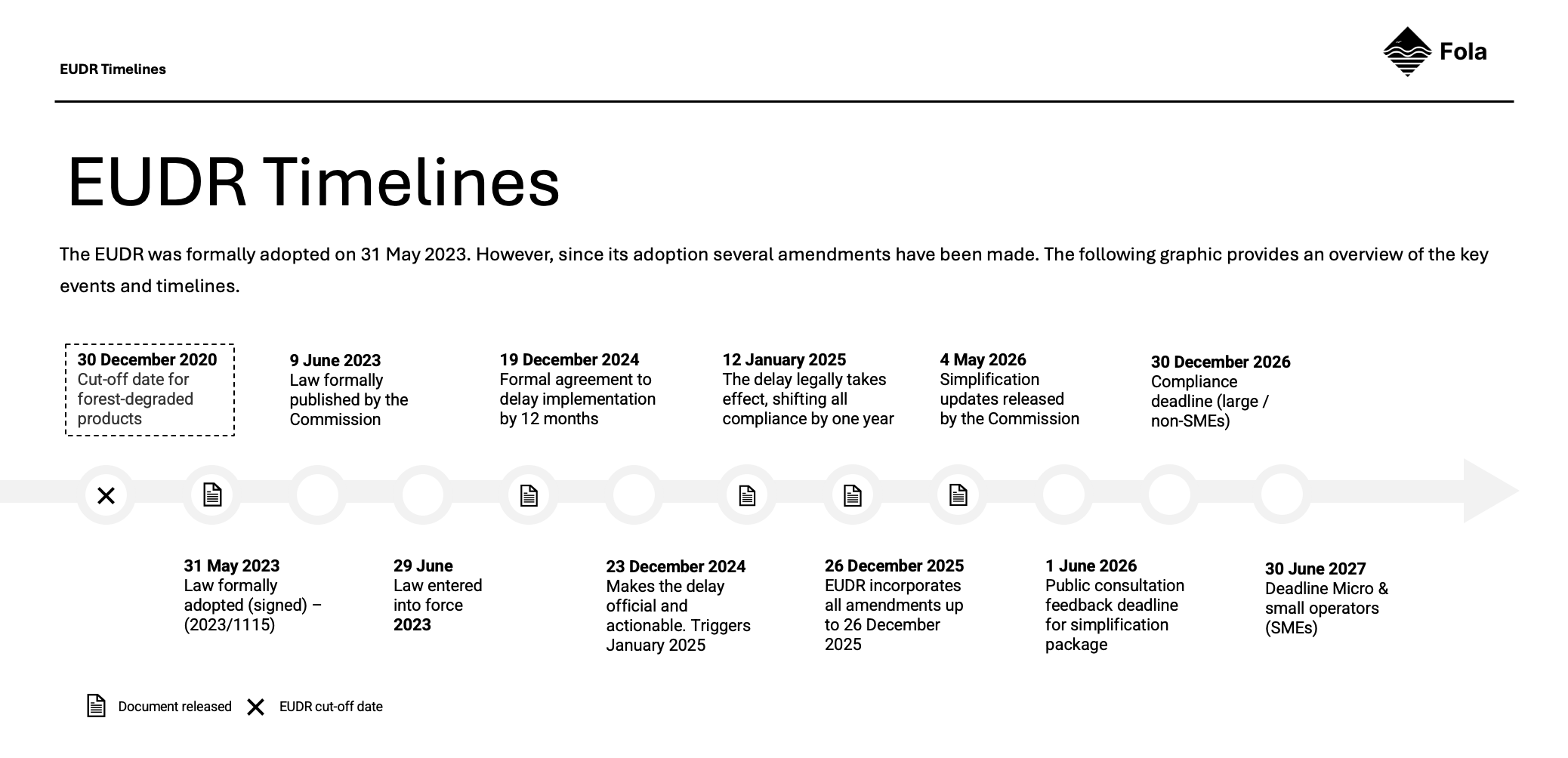
The Commission has now published the first set of materials associated with the 2026 review.
At the centre of the package is a Delegated Regulation proposing changes to Annex I (the list of products covered by the Regulation) which is open for public feedback until 1st June 2026.
In addition, the Commission has also issued separately updated FAQs and implementation guidance, aimed at reducing duplication, improving clarity, and lowering administrative burden for operators.
The most commercially important part of Monday’s package is the proposed update to Annex I, which would materially change the list of products covered by the EUDR.
One of the most significant additions is soluble or instant coffee being proposed for inclusion in scope (under HS 2101 11 00). The Commission’s rationale is that excluding soluble coffee created an inconsistent approach across the coffee sector and risked relocating, rather than eliminating, embedded deforestation. This is likely to be highly relevant for coffee brands, hospitality groups, FMCG businesses, and ingredient buyers who may previously have assumed certain coffee derivatives sat outside scope.
The Commission has also proposed significantly expanding the scope of palm oil derivatives, particularly within the oleochemicals value chain. These products are used widely across personal care, household goods, food ingredients, coatings, lubricants, and industrial manufacturing. For many businesses, this could create entirely new EUDR exposure where none was previously assumed.
At the same time, the Commission has proposed a series of targeted exclusions. These include product samples and goods imported solely for examination, analysis or testing; single-use packing materials and packing containers used exclusively to support, protect or carry another product; reusable packing materials and containers; marketing and informational materials; waste; used and second-hand products; and items of correspondence. Notably, leather has also been explicitly proposed for exclusion. This is a significant development for businesses in apparel, footwear, and accessories that had previously assumed it remained in scope. Most of the non-leather exclusions were already included in the draft Delegated Act published for public feedback in 2025 and have been carried forward as part of the broader 2026 Annex I review.
Importantly, the reduction in annual compliance costs is not only driven by product-scope changes. The biggest cost savings are expected to come from broader structural simplifications across the compliance model, including simplified due diligence for low-risk sourcing, lighter obligations for downstream operators, new simplified regimes for micro- and small primary operators, the ability to cover multiple shipments under a single due diligence statement, and improvements to the Commission’s digital Information System.
Operators relying on simplified due diligence for products sourced from low-risk countries must still collect required information and consider supply-chain complexity, circumvention and mixing risks, but are generally not required to carry out the full risk assessment and mitigation steps under Articles 10 and 11 unless they become aware of information suggesting possible non-compliance.
The updated FAQs / Guidance also show that downstream operators’ role is, in some cases, limited to passive collection and retention of relevant information. This is one of the most practically important simplifications for downstream supply chains.
The Commission has also signalled improvements to its Information System, including enhancements to processing capacity, data handling, and operational resilience. The Information System is expected to reopen in stages from June 2026, with further functionality to follow later in the summer.
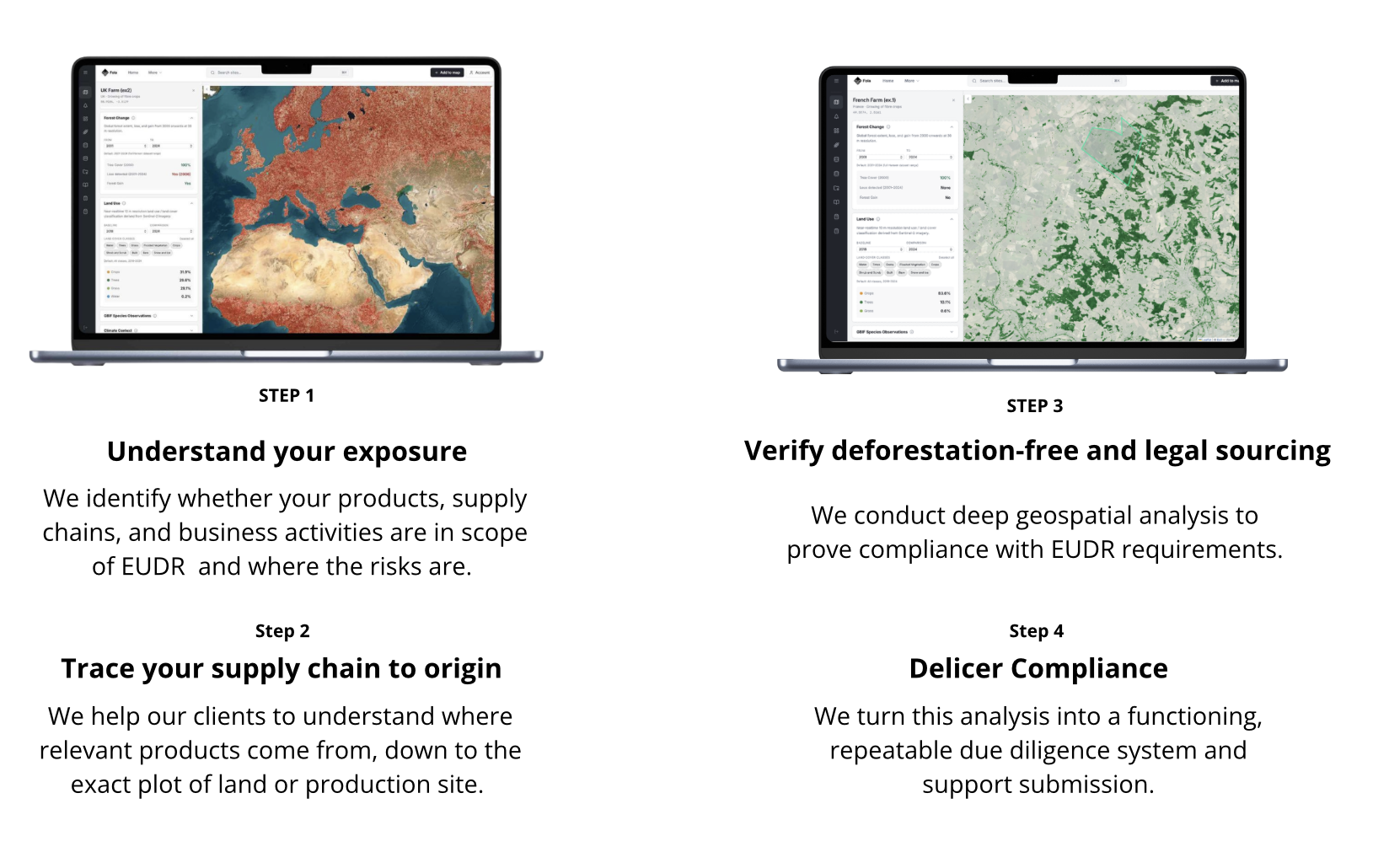
Click here for more: https://www.fola.earth/eu-deforestation-regulation-eudr
The most important commercial implication is that EUDR is no longer a static legal interpretation exercise.
Many businesses have already invested significant time and resources in product scoping, supplier mapping, and due diligence readiness. Today’s update demonstrates that those programmes cannot be treated as complete or fixed.
Companies operating in sectors such as coffee, FMCG, chemicals, personal care, retail, apparel, packaging, rubber, and wood products may now need to revisit their original scope assessments. Products that were previously considered out of scope may fall within the Regulation if the proposed Annex I changes are adopted. Conversely, certain products that created disproportionate compliance burden may now be excluded.
This creates both risk and opportunity. Businesses that maintain static compliance systems may quickly find themselves working from outdated product lists or supplier assumptions. Businesses with agile internal governance, strong product data, and cross-functional alignment between legal, procurement, customs, sustainability, and operations will be better positioned to adapt.
Businesses should not interpret today’s package as a reason to slow down EUDR readiness. Quite the opposite.
This update should be treated as a prompt to revalidate existing compliance programmes and ensure that internal systems are capable of adapting to regulatory change.
In practical terms, organisations should now revisit product classification, customs code mapping, supplier declarations, product master data, and internal role determinations. Any business with exposure to coffee, palm-based derivatives, leather, packaging, rubber, or wood should prioritise these reviews.
Businesses should also ensure that there is a single enterprise-wide interpretation of the updated rules across legal, procurement, sustainability, trade compliance, IT, and operational teams. One of the biggest risks over the next 12 months is not lack of awareness of the EUDR, it is inconsistent interpretation of what the latest updates actually mean.
